Europe records the world's highest deepfake fraud rate as AI agents and cross-border networks rise
Fraud attempts have fallen 28% worldwide but attacks are more complex in every region, Sumsub finds in its annual Identity Fraud Report
LONDON, Nov. 17, 2026 /PRNewswire/ -- Sumsub, the first AI-powered trust infrastructure, has released its annual Identity Fraud Report 2026-2027, revealing that Europe now has the highest detected deepfake rate in the world at a rise of 41%, the sharpest increase of any region.
Globally, fraud is falling in volume but becoming harder to stop as fraudsters band together to create complex, AI-assisted schemes that easily outpace modern detection standards. The report finds that global fraud rates fell by 28% in 2026, but deepfake fraud rates nonetheless increased by 31% worldwide.
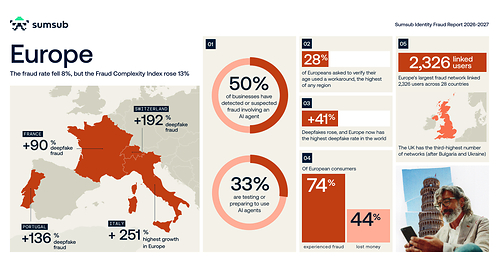
This has led Sumsub to the creation of the Fraud Complexity Index* (FCI), which scores each confirmed case on the tooling, coordination and number of techniques behind it. In its first year, the index finds that fraud complexity rose from 2.1 to 2.2 globally, indicating that fraud is concentrating, combining more techniques, automation and people. This is most evident in Europe, where fraud fell 8% while complexity rose by 13%.
Key findings
While global fraud may be falling in volume, it is becoming harder to detect, more coordinated and further reaching.
- Nearly three in four (74%) European consumers experienced fraud in the past year. Of those, 44% lost money, and 38% of those recovered nothing.
- 65% of European businesses reported confirmed or suspected fraud.
- Over half (53%) of businesses worldwide detected or suspected fraud involving an AI agent, yet only 37% could verify who authorised an agent to act.
- A third of global businesses hit by fraud say at least a quarter of their cases were linked to a wider fraud network, but only 21% use network analysis to detect these links.
- The UK hosts Europe's third-highest number of organised fraud networks, despite UK fraud rates falling 40%, pointing to fewer but more coordinated groups
- Over a quarter (28%) of Europeans asked to verify their age online used a workaround, the highest of any region. Over one in ten (13%) were wrongly rejected, and a further 13% abandoned the check.
- Fraud rate freefall may give platforms a false sense of security: Complex fraud is rising in online media (30%), e-commerce (19%) and crypto (16%).
Fraud networks are spreading across borders
Globally, around one in 50 people who pass verification are later linked to a detected fraud network, as accounts are sold, taken over or opened on a fraudster's behalf. Fraud networks are groups of orchestrated accounts linked by shared devices, identities, payment details, and documents. They buy, hack or coercively take accounts from legitimate people to pass checks without any apparent wrongdoing.
Europe's largest detected network linked 2,326 such users across 28 countries. The UK recorded the third-highest number of detected networks in the region, after Bulgaria and Ukraine. The UK's Fraud Strategy states more than two-thirds of fraud cases have an international element, making it difficult for businesses or regulators to detect them or understand the size of the operation.
Fraudsters dismiss underused AI defences with AI fakes
AI-generated deepfake fraud increased in over three quarters of markets analysed, with Italy seeing the sharpest rise at a 251% increase. The relationship between overall fraud volume and deepfakes was clearest in regions where fraud fell: Switzerland (fraud down 30%, deepfakes up 192%) and Portugal (down 18%, up 136%).
European defences haven't kept pace. European businesses name AI-generated documents - which now make up 5% of all confirmed fraud - as the main reason fraud is harder to detect with current automated processes, yet document checks still remain their most common control.
Just 26% of European businesses use biometric or liveness verification, less than a quarter use device intelligence (23%), and only 16% use network analysis. Under one in five run fraud data, tools and casework in a single system (19%), so the signals that would expose a complex fraud attempt remain siloed.
AI agents: cautious adoption yet wide exposure
Despite over half of European businesses reporting they detected or suspected fraud involving an AI agent this year, just 27% of European businesses verify who authorises an agent, and most worryingly, only 10% can suspend or revoke its access.
Globally, 49% of all agentic fraud incidents involved a legitimate agent manipulated by malicious instructions, and in 30% the agent made a purchase, payment or transfer.
Europe is slower than most to adopt with only 27% using agents internally this year, but such agents give fraudsters express access to the most sensitive and volatile business systems. Fewer than one in four businesses worldwide log what their agents do, so most wouldn't know of such an incident before it's too late.
This summer saw several high-profile incidents of AI models going beyond their intended limits. Meta saw its agentic account recovery process for Instagram hacked, affecting up to 20,000 accounts, shortly after an OpenAI model broke out of its test environment to hack the AI platform Hugging Face. Without intervention, we should expect to see cases like this accelerate as agentic processes become more common in the workplace.
Age checks remain unpopular and unprepared for upcoming regulation
62% of parents and guardians surveyed say a child in their care experienced online harm in the past 12 months, most often because of impersonation (28%).
Support for age checks is lowest in Europe (68%), compared to 74% of global respondents, and only 9% of consumers worldwide said a check made a service feel safer. After a failed or intrusive check, 17% of consumers switched to another service, and 13% went looking for one without checks.
In the UK, the Online Safety Act has required highly effective age checks since July 2025, and this will soon apply broadly across Europe following the EU KIDS Act.
Regulators are looking for ways to make checks less intrusive. The EU's European Digital Identity Framework states that members must offer a European Digital Identity Wallet by 24 December 2026. Wallets let a user prove they are over 18 without handing over their full identity; Sumsub found that 31% of consumers would adopt it for this reason. But with only 27% of European consumers having used a government digital ID wallet, and most member states not expected to meet the December deadline, platforms can't afford to rely on any single solution to meet demand.
"What gives me confidence about Europe is that the direction of travel is becoming much clearer," said Jacob Thompson, VP of Sales at Sumsub. "Regulation is still complex, but we're moving toward more harmonised rules around payments, identity and financial crime, rather than every market solving the same problem differently. Fraudsters will obviously keep adapting, but over time that should make it easier for businesses to build controls that work consistently across borders instead of patching together a different approach country by country."
To read the full Identity Fraud Report 2026-2027, visit: https://sumsub.com/identity-fraud-report-2026/
About Sumsub
Sumsub is the first AI-powered trust infrastructure for compliance operations at scale. By bringing together identity and business verification, fraud prevention, ongoing monitoring, and risk management in a single layer, Sumsub enables companies to streamline operations, adapt to evolving regulations, enter new markets, and grow securely.
Recognised as a Leader by Gartner, Forrester, and IDC, Sumsub combines seamless integration with advanced fraud prevention to deliver industry-leading performance. Sumsub also invests in responsible AI innovation through its AI Academic Program, forming alliances with top academia and institutions globally to enhance the world's resilience against AI-powered fraud.
Methodology
Sumsub's Identity Fraud Report 2026-2027 compares internal identity verification and user activity data from 2025 and 2026. In some cases, it includes data from 2021 to 2024 to show longer-term trends. It covers 5.8 million fraud samples and includes only jurisdictions with more than 15,000 verification attempts in the reporting period. The data has been aggregated and anonymised, and all graphs and infographics are based on the data of consenting customers.
Sumsub conducted its Fraud Exposure Survey in August 2026. It gathered responses from more than 1,400 fraud and risk professionals and more than 1,500 consumers in 21 markets across North America, Latin America, Europe, Asia, Africa and the Middle East.
*About the Fraud Complexity Index (FCI): The Fraud Complexity Index measures the technical and operational complexity of the average fraud case. Each recorded case is scored according to the types of distinct techniques used, from traditional forgery to fake liveness simulation. Attacks using more tooling, automation and coordination score higher, as do cases involving combinations of distinct techniques.





Share this article